 Weather Slate
Begin with a time and a place
“Saturday looks wet” is a broad statement. “We are setting up a graduation party from 10 to noon” gives the weather a useful frame. The meaningful information is the forecast at that place during that window, plus enough time on either side to prepare and pack up.
The same approach works for soccer practice, a wedding, a road trip stop, a morning run, camping, or a photography session. Each activity emphasizes different factors; the start time alone is not the whole plan.
A real pre-release concept
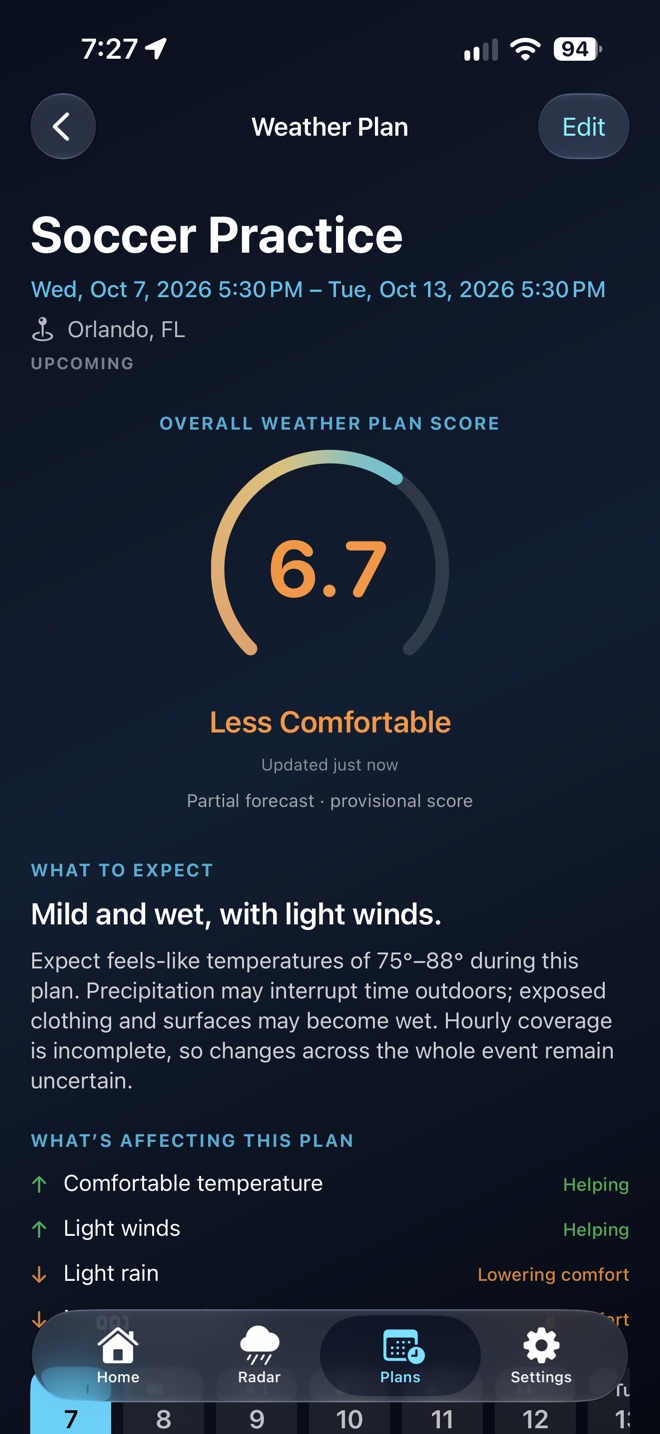
The screenshot on this page is a genuine Weather Slate development screen. It brings a plan’s title, location, dates, comfort score, and explanation together. Weather Plans remains in development; seeing a working screen is not a promise that every planning feature is ready for public release.
Weather Slate’s summaries are calculated in the app from weather information. The app does not use generative AI. The purpose is to explain the weather clearly, not invent a confident story where forecast information is incomplete.
Read partial outlooks honestly
A plan can extend beyond the hours for which detailed data is available. In that case, pay attention to partial-forecast and provisional-score notices. Conditions for one part of a multi-day event should not be mistaken for a complete outlook.
Revisit the plan as its date approaches. A useful update may change the timing, equipment, or backup arrangement without changing the event itself. Weather planning is a sequence of decisions rather than a single score collected once.
Use the factor that matters to your activity
- Sports: consider the full practice window, field condition, exposure, and the organizer’s safety rules.
- Celebrations: include arrivals, setup, guest comfort, and teardown.
- Travel: check separate places and times without assuming a forecast provides route guidance.
- Photography: compare light, wind, and precipitation around the shoot.
Planned calendar import and event tools follow this same philosophy. None of these replace official hazard guidance or decisions by a responsible event organizer.